Base first
Base Mainnet is proposed as the initial network. The token is not deployed, and the page does not imply a live contract.
A working document for testing how future T5D utility could coordinate support quality, provider capacity, and ecosystem participation after real support activity exists.


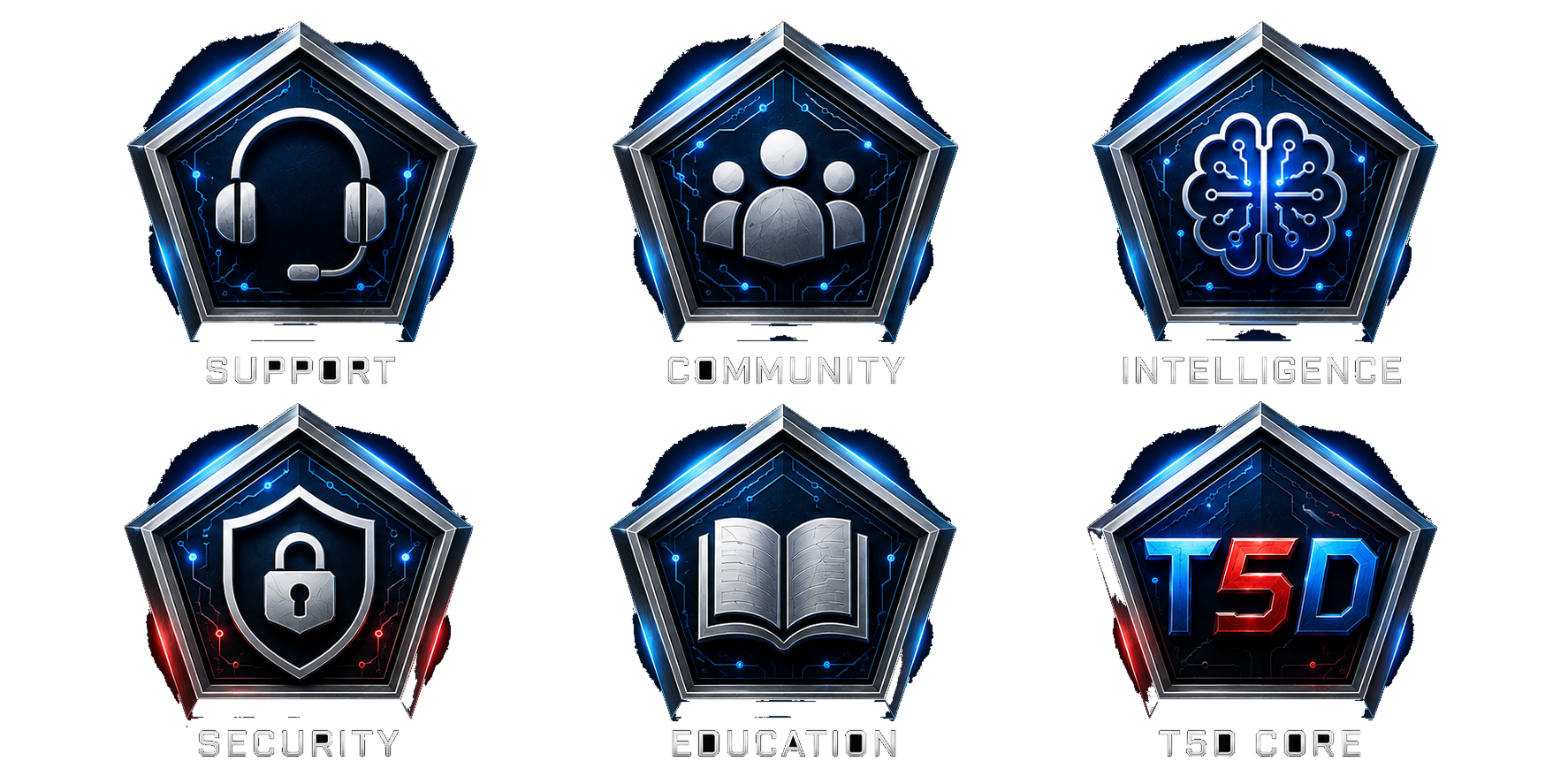
The supplied T5D icon family gives the proposed utility a consistent visual vocabulary: support, community, intelligence, security, education, and the T5D core.
The foundational direction is confirmed. Everything involving token mechanics, economics, distribution, pricing, settlement, rewards, or penalties is a design exercise until governance, legal review, technical tests, and real support data exist.
Base Mainnet is proposed as the initial network. The token is not deployed, and the page does not imply a live contract.
Expansion to other chains is a later phase, subject to interoperability research, security testing, and operational readiness.
Token utility follows real support activity. No exact launch, contract, eligibility, or economic terms are established here.
The proposed model treats the future token as economic glue around support demand, decentralized AI capacity, human quality review, and verified participation. The sequence is intentionally incomplete.
dApps and communities define support needs through future service arrangements. Pricing, service levels, and settlement assets are TBA.
Community-run AI nodes could accept support work and contribute model capacity. Node requirements, hosting costs, security stake, and compensation are PROPOSED / TBA.
Human validators could review quality and disputed outcomes. Selection, evidence, quorum, appeals, and rewards remain UNDER DESIGN.
Verified assistance, useful knowledge, education, and resolution quality could become the basis for future recognition and utility.
This is a draft control model, not a finalized protocol rule. Automated analysis may help route work or trigger review, but it must not directly slash a node or validator.
A user rating and basic outcome signal could enable fast-path settlement when the signals align within pre-defined confidence bounds.
Automated sentiment analysis could flag an interaction for audit, but sentiment confidence is capped and cannot directly slash.
Randomly selected human validators could determine final disputed verdicts through encrypted or commit/reveal review.
Future dApp service access is proposed around operational commitments rather than fixed token thresholds. Exact bands, savings, service levels, and margin tests are TBA.
USD or stablecoin-denominated service pricing with no long-term commitment. Exact service units and rates are TBA.
Discounts could reflect monthly volume or prepaid service commitments, subject to positive contribution margin.
Enterprise service levels could use negotiated annual commitments and documented operational requirements.
A future token-linked rebate or participation layer could be evaluated only after liquidity, custody, compliance, and margin readiness.
Customer service commitments and deposits must remain separate from node or validator security stake.
Service access should not grant control over validator selection, slashing, treasury, bridge security, or monetary parameters.
Any discount, rebate, burn, or treasury allocation must come after provider costs and operating requirements are covered.
Assumption: PROPOSED / TBA total supply cap of 1,000,000,000 T5D. The following allocation and vesting descriptions are draft planning inputs only.
| Allocation | Share | Illustrative units | Proposed vesting concept | Status |
|---|---|---|---|---|
| Node Mining & PoSpt Rewards | 40% | 400,000,000 | Long-duration emissions tied to verified support activity; schedule TBA. | PROPOSED |
| Private / Strategic Rounds | 10% | 100,000,000 | Lockup and linear release concept; timing and eligibility TBA. | PROPOSED |
| Community Presale | 7% | 70,000,000 | Illustrative allocation with staged release; activation, terms, and eligibility TBA. | PROPOSED |
| Ecosystem & Growth | 18% | 180,000,000 | Milestone-based grants, partnerships, and ecosystem programs; schedule TBA. | PROPOSED |
| Core Team & Contributors | 15% | 150,000,000 | Extended lockup and vesting concept; final terms TBA. | PROPOSED |
| Public Sale / Liquidity | 5% | 50,000,000 | Future market-structure planning only; activation and controls TBA. | TBA |
| Foundation / Treasury | 5% | 50,000,000 | Governance-approved reserve concept; custody, release, and reporting TBA. | PROPOSED |
Label discipline: The percentages and units above are all PROPOSED / TBA. They are not a live supply statement, allocation promise, or eligibility notice.
A visual look at the current proposed structure behind T5D—balancing community rewards, development, participation, liquidity preparation, and long-term stewardship.
Future node mining and Proof of Support participation.
Growth programs, partnerships, and building the support layer.
Core builders and the people moving the work forward.
Future aligned participation with long-term release planning.
Proposed early community access.
Future public access and liquidity preparation.
Longer-term stewardship and operating resilience.
The current allocation is a working proposal designed to connect the community, the work, and the infrastructure needed to grow T5D.
A simple view of how T5D is designed to connect support agents, future node capacity, service and DeFi rails, human review, and the wider community.
Questions and requests from users, communities, and dApps.
AI and human-assisted pathways focused on useful resolution.
Shared records, support tooling, and proof-of-support direction.
Community-contributed compute and support capacity.
Proposed review and learning loop for outcomes that need another look.
Future settlement, access, and utility design as the system matures.
Participants, builders, and future rewards aligned around useful support.
People and bots ask for help. Support agents create useful outcomes. Future node operators add capacity, while the T5D shield helps keep the service path clear around a future DeFi and service platform.
 T5DSUPPORT PATH
Clear access · support context · future settlement design
Requests and outcomes move through the T5D layer.
Future nodes add scalable help where it is needed.
Useful contribution can inform future recognition design.
Quality review remains available when more context is needed.
Each support request is intended to move through a practical work loop, a quality loop, and a future service loop—so the people using T5D see helpful support while the system learns where more capacity is useful.
The support agent understands the question, gathers context, and identifies the help or capacity needed.
INPUT: support requestThe support layer records the task and can match compatible future capacity to the part of the work that needs it.
OUTPUT: capacity requestFuture community nodes can provide compute, model capacity, or support assistance and return a work result.
OUTPUT: work resultOutcome signals guide improvement. Human review is available for work that needs a closer look.
OUTPUT: verified signalFuture service and DeFi rails can support access, usage records, and settlement design as the ecosystem matures.
OUTPUT: service recordAgents shape the task. Nodes add capacity. The result returns to the support experience.
Useful outcomes build a feedback trail; exceptions can move toward human review and improvement.
Future rails connect service use to access, reconciliation, and longer-term capacity planning.
This is the proposed direction for the infrastructure—not a live protocol diagram. The focus is simple: make support more useful, capacity more connected, and participation easier to understand.
T5D has no official token price, sale valuation, raise target, or active contribution route. A future price will be published only after the project can show the assumptions that create it, the buyer protections that apply to it, and the independent facts needed to verify it.
A dated capital plan will identify the approved first-stage operating, security, compliance, custody, and liquidity-preparation needs before a raise target is chosen.
The final community allocation must be confirmed as a token count, with every other supply allocation, custody route, and release schedule disclosed alongside it.
Gross USDC-equivalent raise target divided by the final community-sale token pool equals the stated fixed sale price. Rounding, fees, and quote expiry must be shown.
Per-wallet limits, eligibility, delivery or vesting, a support path, and a no-private-message payment rule must be published before any wallet action.
| Public pricing disclosure | Current state | What must be published before activation |
|---|---|---|
| Official T5D price | NOT SET | USDC price, calculation basis, quote duration, rounding, and any applicable fees. |
| Raise target and use of proceeds | NOT SET | Approved capital plan, gross target, material reserve policy, and reporting cadence. |
| Community-sale pool | PROPOSED 7% / 70M | Final token count, allocation control, purchaser limits, and delivery or vesting treatment. |
| Supply movement and liquidity | NOT SET | Allocation custody, release schedule, liquidity process, and recurring transparency report. |
| Official purchase route | NOT ACTIVE | Dated activation notice, verified contract and asset routes, buyer terms, and official support contacts. |
Future community funding is intended to help T5D continue building its support infrastructure and operating foundation. The categories below show where that work may need resources as real requirements emerge.
Engineering, product design, testing, security work, documentation, and continued maintenance of the T5D support infrastructure.
Hosting, monitoring, data-provider access, API services, security tooling, and core operating reliability.
Secure equipment, testing environments, storage, and reliability infrastructure where supported by the approved operating plan.
Carefully scoped contractors, advisors, engineers, designers, support staff, or other qualified contributors where needed.
Software or intellectual-property licensing, legal counsel, policy work, accounting support, contracts, and other professional review.
Security, custody, and technical preparation for any later market-structure work. It is not a listing, price-support, or buyer-outcome promise.
| Before a price is set | Required public disclosure |
|---|---|
| Planning horizon | Milestone-based review periods rather than an assumed burn-rate forecast. The applicable review period and priority work will be stated when final terms are published. |
| Budget scope | Approved first-stage milestones, planned coverage period, and category-level amounts or ranges. |
| Capital controls | Custody model, signer policy, spending authority, contingency treatment, and a definition of material budget changes. |
| Reporting | Reporting cadence, use-of-proceeds format, and the official public source for material updates. |
| Material changes | A dated update will identify the decision basis, categories affected, and revised outlook when a material change to priorities, custody, liquidity policy, or the planned coverage period is approved. Urgent security or legal actions may be reported after action with an explanation. |
| Liquidity preparation | A separate published policy, multisignature controls, route or venue disclosures, and execution reporting before any action. |
As real operating needs emerge, T5D proposes to review costs in a visible sequence rather than assume permanent public percentages. The aim is to keep the focus on useful work, clear priorities, and straightforward community updates.
| Proposed priority | Category | What must be recorded before use | Control boundary |
|---|---|---|---|
| 01 | Product development and security | Defined milestone or security need, scope, expected cost/range, delivery evidence, and approval date. | Major commitments will link to a defined scope or milestone. |
| 02 | Core operations | Service terms or invoice, operating purpose, review date, and payment record. | Renewals and usage changes stay aligned with the current operating plan. |
| 03 | Specialist capacity | Engagement scope, conflict review, deliverable, cost/range, and approving signers. | No open-ended contributor commitment without a dated update. |
| 04 | Licensing and legal/compliance | Purpose, provider, scope, cost/range, and supporting approval record. | Not a statement that any legal requirement or tax liability has been determined. |
| 05 | Liquidity preparation | Separate policy, custody and signer controls, route or venue review, limits, and post-action report. | Never automatic; not a price-support promise. |
| 06 | Contingency reserve | Dated reason, affected category, approval record, and revised outlook. | An unallocated reserve is not a discretionary spending category. |
These questions need evidence, modeling, legal review, security review, and community process before any protocol implementation or public economic commitment.
Before any future utility decision, run sensitivity analysis across token price, support volume, fast-path and audit rates, provider costs, fee splits, discounts, and synchronized unstaking. The gate is simple: every tier must remain operationally and economically coherent across the tested range.